I am a transgender woman. I have known this on the inside for a long time but have only accepted this on the outside for a short time. There were a lot of reasons to why I stayed closeted for so long: there were people in my life who I knew wouldn’t accept me, I feared being alone, and I hated myself for having thoughts of transitioning. I’m out now, I’m myself now and because of that, I have family members who don’t speak to me anymore; friends I’ve had since childhood cut me off, when I go to my hometown, I have nobody left there who will speak to me apart from my immediate family and even they took some time to accept me. Despite all of that, the pain I felt each and every day pretending to be someone I never was is so much worse than being myself and alone.
Before I delve into speaking on this film using a trans lens, I want to emphasise how beautiful this film is in sight and sound. There are multiple phenomenal shots that use colour in the most pleasing way. The majority of this film is set at night without falling to the common struggle of losing visibility; every scene has amazing lighting that allows the colours to pop. It’s refreshing to see a modern film be so creative with its editing, the handwritten notes on the screen during the one shot through the school is such an interesting visual. The soundtrack is littered with talent that fit the aesthetic perfectly, Caroline Polachek’s record being an extremely fitting score for its scene. Even without the underlying messaging, this film is a powerhouse of art.
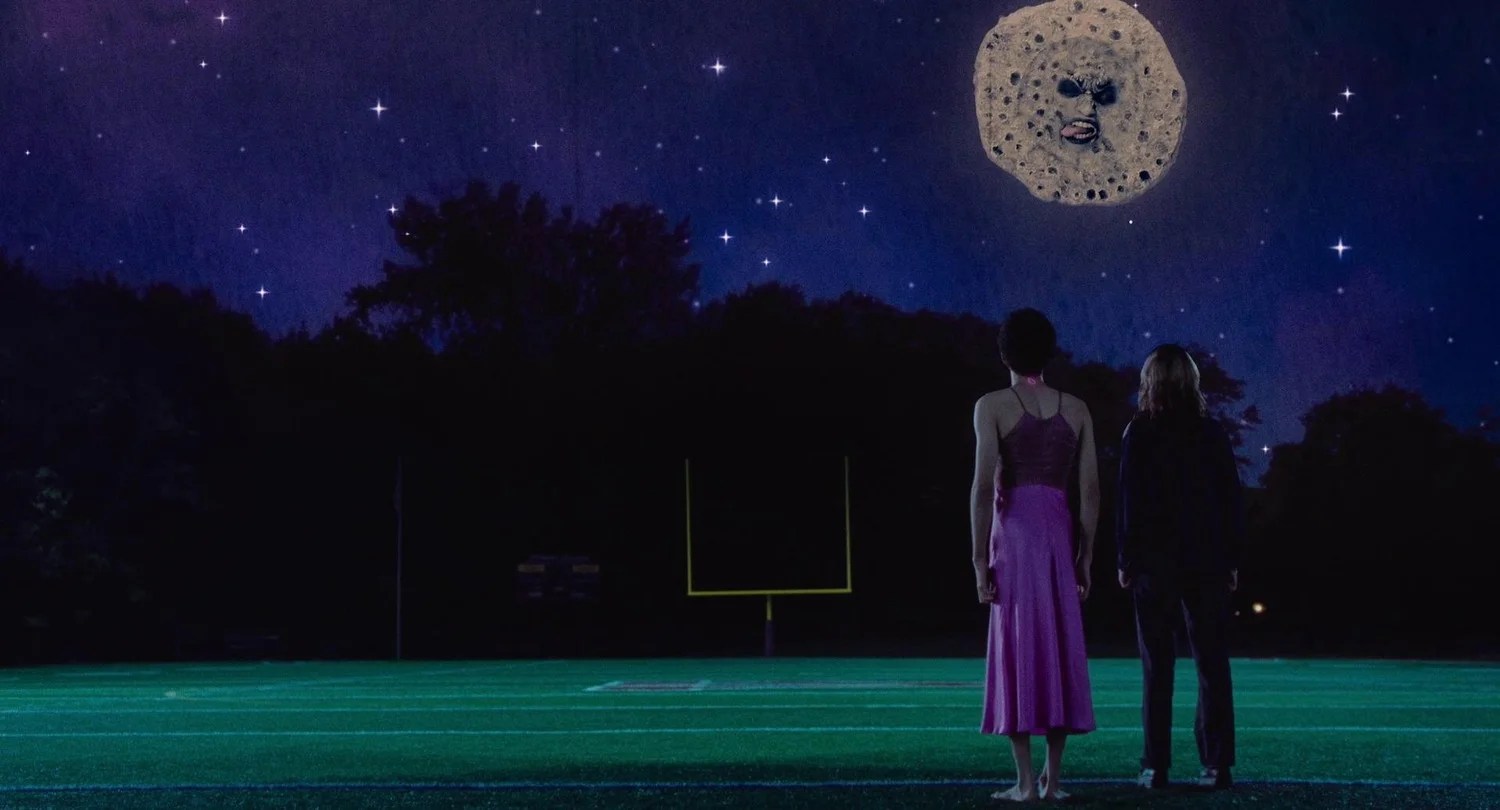
It’s really scary to be a transgender person right now; a lot of people hate out existence and a lot more don’t even understand us. The ignorance (intentional or not) of trans people goes so far that it was popular to claim this very obvious metaphor of a film has no relation to the transgender experience. I Saw The TV Glow never explicitly mentions the word transgender but it may be one of the most allegorically trans films ever.
The film follows Owen (Justice Smith) and Maddy (Jack Haven) through their adolescence and their obsession with the tv show ‘The Pink Opaque’. The characters form their relationship based on their mutual interest of the show, Maddy being the one to encourage Owen to sneak away from his parents so they can watch together.
Owen is an awkward, uncomfortable person, which are traits that could easily be mistaken as just a typical teenager, but his thoughts and actions are so relatable to every trans viewer. Growing up in a body that is uncomfortable to exist in can feel like watching your life happen without you in control, just a passenger helplessly standing by. When alone with Maddy, Owen confesses his fear of what is inside him and how he is afraid to open himself up, which is a common inner conflict of the trans variety.
Maddy, however, is confident in their identity throughout, being open about being a lesbian and is actively striving towards finding an environment to be comfortable in. They do this by escaping their abusive home life, running away, changing their name and starting a new life in a faraway place. Maddy knew they would die if they didn’t leave, whether it be through suicide or queer-targeted violence, but they came back years after their disappearance to save Owen as well. The first time Maddy left, they tried bringing Owen with them, but he refused; he was scared of committing and ran away from his issues. This reads as Owen rejecting his conflict surrounding his identity, as a lot of trans people do; he is suppressing his feelings to continue a life that he doesn’t enjoy, but doesn’t have to deal with the struggle of change.
This is a horror film but instead of a big bad monster, the fear comes from time. The world is created for cisgender heterosexual people; they get to live their entire life as themselves. Queer people do not get that privilege; the majority aren’t allowed or are able to live authentically until they are adults. Most cishet people have fond memories of their childhood and adolescence, while queer people often have no memories at all because they repress the years they spent hiding. Owen and Maddy both express their discomfort that comes at the hands of time, both admitting that the passage of time doesn’t feel normal, and they’re feeling like they are missing out on life. This is portrayed so well by the first time jump, which is only two years: Owen goes from 13 to 15 years old, but the actor goes from Ian Foreman (12 years old) to Justice Smith (27 years old). Obviously aging two years is not as dramatic a change as that, and Smith does not pass as a 15-year-old, but this just shows that time does not exist the same way for queer people. A year can feel like a second when you’re not living as your authentic self. Life is a constant race against the clock; every moment feels closer to the moment you realise that you’re out of time and it’s too late to live.

The scariest frame of any film that I have ever seen is Owen at his new job, skin dry and wrinkly with ‘20 years later’ written on the screen. The whole film, you’re hoping that he’s going to have that moment where he decides he will discover and embrace his true self but time keeps moving forward faster and faster.
On first watch, I hated the ending, seeing Owen actually accept his true identity but realising he had wasted the majority of his life pretending to be someone he’s not, crushed me. His screams and cries for help were genuinely harrowing as it seemed to set in that he is too late. A small glimmer of hope arises as he cuts his chest open to reveal the glow of a television inside of him. Finally, it seems like Owen is opening himself up (literally and figuratively) and allowing his inside to come outside, even if he has lost so much time, he still could enjoy the rest of his time. But then he closes back up and apologises for what happened. The screen went black, and I saw my reflection, tears streaming down my shocked face, and in that moment, it felt like I had been hit by a truck. I couldn’t breathe, I couldn’t speak, I could just lie still and weep until I ran out of tears.
Before his tragic ending, Owen wondered if he would have had a better life if he had left with Maddy. This is regret, it’s a regret that every transgender person has for not starting their transition earlier. Every day that passes without transition is a day lost. The episode of catastrophic suffering that Owen experiences is one I and many trans people have been through, where we are scared that we will never be able to be our authentic self, and it was terrifying to watch it unfold. I thought I needed Owen to have a happy ending. I wanted time to be reversed so he could have gone with Maddy and opened himself up and found comfort. The truth is I needed the ending we got. Every time jump felt like a gunshot, it physically hurts me to watch this film. Every time jump was also a reminder that time can move so fast, and everyone has a limited amount of it so it’s best to use this time to live life happily rather than in fear.
I’m so happy this movie exists. A younger me would have watched this and it would have terrified her, she would have cried herself to sleep for nights but I think it would have helped her be herself a lot earlier than it happened. I love the idea that young people will watch I Saw The TV Glow and it will help them in some way which could be an egg cracking moment or the push they need to begin living as themselves. I hate the idea that some people will watch and will feel a deep pain in their chest that reminds them of the feelings they have suppressed. I hope the “there is still time” message rings true for these people. A lot of mainstream trans media is either made for cis people or has a harmful representation of trans people. This film feels like it is made for us. It’s not a motivational movie that tells us that everything is going to be okay. It’s an authentic representation of the worst nightmare every transgender person has thought about. To many, the options are transition or death but this film is a worse fate than dying: living while knowing you’re in the wrong body.

 i've seen jaws